The 2026 Class of Healthcare's Uninsured

Howard Yeh is a co-founder of Healthcare.com with two decades of experience building companies in healthcare, insurance, and digital distribution. More about Howard →
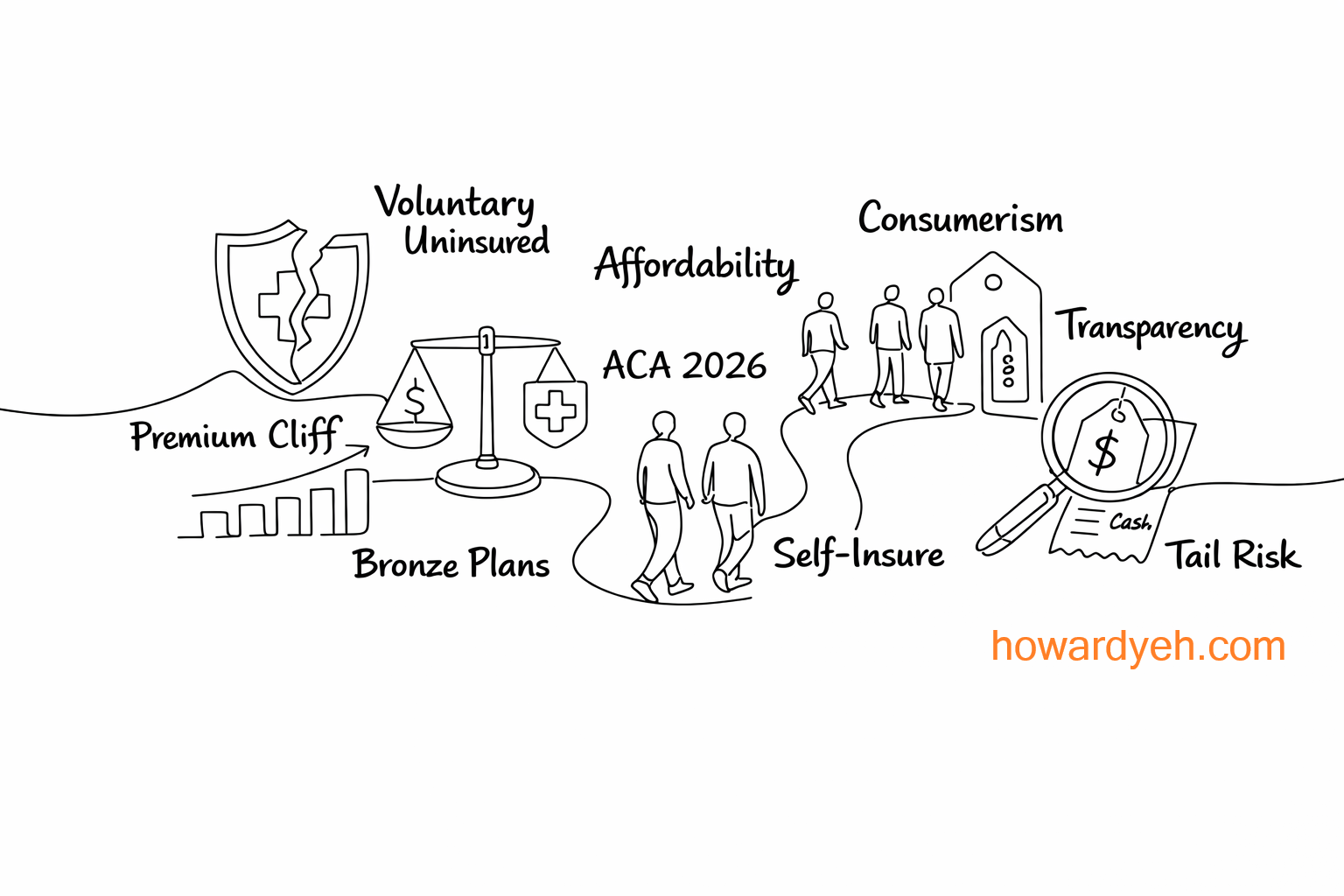
Last week, I spoke on a panel about Consumerism in Health Insurance at the William Blair Benefit Technology Conference. Part of the discussion centered on individual enrollment decisions — and the industry's expectation that the uninsured rate will rise as enhanced ACA subsidies expire and premiums rise.
This post is focused on the segment of consumers that I'm calling the voluntary uninsured — individuals who technically have access to coverage but decide the premium, deductible, or total out-of-pocket exposure doesn't justify the cost.
For context, a new Urban Institute report finds that marketplace benchmark premiums (i.e., the second-lowest-cost silver plans) have increased by an average 21.7 percent. The same report cited that the number of uninsured would go up by 7.5 million individuals.
This outcome was never surprising. The enhanced subsidies were temporary by design.
But what's more interesting to me is how the composition of the uninsured continues to change.
Historical Context on Uninsured
We're talking about a different kind of uninsured than what existed before the ACA came to be.
Before the ACA was passed in 2010, many people were uninsured because they were uninsurable by the industry. Medical underwriting, exclusions, waiting periods, and outright denials were commonplace in the individual major medical market. It meant coverage was not simply expensive — it was unavailable. The free market had left these individuals behind. If you were in that unfortunate situation, your solution was state-based, non-profit high-risk pools which had no guarantee of coverage.
The ACA was designed to eliminate that structural exclusion in the individual market, with core features such as: a) Guaranteed issue during open enrollment, b) Protection for pre-existing conditions, and c) Defined enrollment windows to prevent adverse selection.
If you enrolled during the appropriate period, you could not be denied coverage for an ACA Marketplace plan (still true today).
That baseline safety net matters. And it generally functions well for the most vulnerable.
A New Class of Uninsured
The uninsured population in 2026 is different.
It's less about access and more about affordability and behavior.
When enhanced subsidies that were introduced in 2021/2022 reduced net premiums — in some cases to $0 — enrollment increased. Lower friction and lower price naturally improve take-up. The Biden administration prioritized gross enrollment numbers, and we saw total ACA enrollment more than double, from 11 million in 2020 to 25 million in 2025.
However, as subsidies normalize, many consumers are re-evaluating the cost-benefit tradeoff. The "Affordability" in the Affordable Care Act is now the concern.
Some will stretch to maintain coverage, especially if they have conditions they need to support or have lower risk tolerances. Some will move to non-ACA alternatives. Some will simply opt out and choose to self-insure.
That last category is the one I've been thinking about. The segment that chooses to self-insure are not the structurally excluded. (I'm going to exclude those who missed enrollment windows, had a subsequent medical event and are now stuck waiting until the next Open Enrollment.)
As mentioned earlier, this post is about the voluntary uninsured — individuals who have access to coverage but not at the current cost.
That is a different policy and market problem.
But when affordability tightens, behavior adjusts.
The implication is that more healthcare costs and financial risk shifts directly onto households. I argued on the panel that this is a positive dynamic for healthcare consumerism, provided there is price transparency in the cash-pay market for care.
Managing High-End Risk For This Class of Uninsured
Voluntary uninsured consumers face a different set of risks. One that's immediate and direct: Large, unpredictable medical events.
Going completely uninsured is rarely prudent.
They can (and should) get supplemental insurance for the catastrophic scenarios. Accident/Health, Hospitalization, Critical Illness. These are private forms of insurance, some of them underwritten, to cover some fixed amount of unexpected costs, and hopefully enough to bridge you to the next Open Enrollment to enroll into a Marketplace plan if there are continuing costs.
In theory, these consumers are making rational economic choices. However, there are also hidden risks and costs that they may not be considering, including price opacity, care deferral decisions, and both financial and health-related instability from delayed treatment.
In practice, many underestimate tail risk.
The Opportunity Presented by This Class of Uninsured
From a market perspective, this shift has second-order effects.
A larger voluntary uninsured population increases demand for:
- Transparent pricing
- Point-of-service decision support
- Trusted advisory channels
- Alternative coverage designs
When consumers carry more first-dollar exposure, they behave differently. They shop differently. They delay differently. They ask different questions. We'll see the emergence of more cash-pay in healthcare. And when consumers are making their own decisions, and the costs aren't obfuscated by a third-party payor, then healthcare consumerism can then take shape.
(As a side note, we're going to see this dynamic even in the insured class, as more ACA consumers shift to higher-deductible Bronze and Catastrophic plans.)
At the Blair conference, our moderator Charlie Deason asked the panels to encapsulate where we were with healthcare consumerism in one word. My answer was, "Finally".
I'm not saying having more uninsured Americans is a good thing. It's what it is, and hopefully the industry can use this as a forcing function. The uninsured rate rising in 2026 doesn't mean we've returned to pre-ACA exclusion.
It means affordability elasticity is reasserting itself, and the market needs to adapt with more ways to serve consumers.
That's a more nuanced — and more economically grounded — conversation than the headline statistic suggests.
Are you seeing more of these consumers?
Is this a temporary recalibration?
How is the market, both insurers, insurance brokers, and healthcare providers, adapting?
Is this a structural shift in consumer risk tolerance?