Reflections on Incentives, Growth, and the 2026 Shift in ACA & Medicare Advantage

Howard Yeh is a co-founder of Healthcare.com with two decades of experience building companies in healthcare, insurance, and digital distribution. More about Howard →
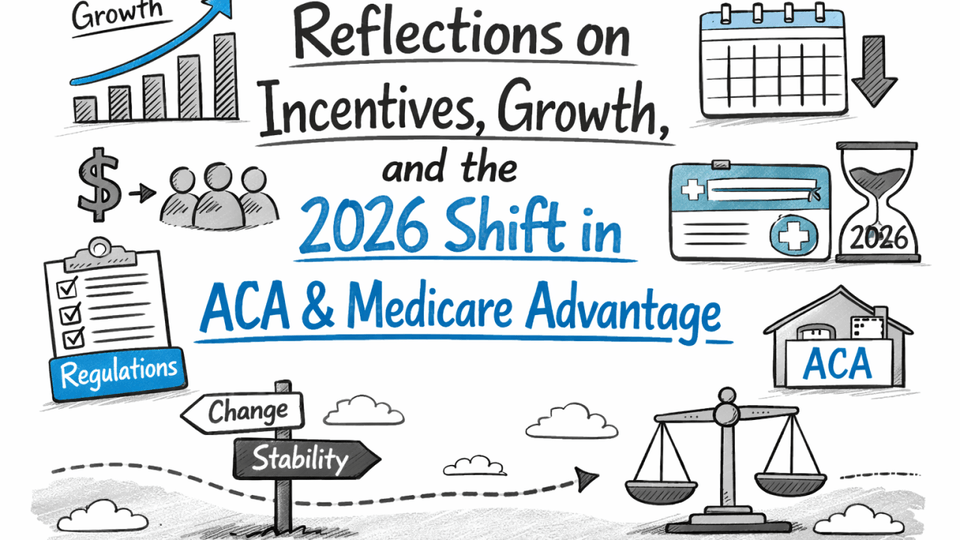
I've been thinking recently about how often regulations have unintended consequences.
The intent of these regulations usually comes from a good place — protect vulnerable populations, expand access, improve affordability. But once the rules hit the market, the market adjusts, sometimes through strategies optimized for short-term enrollment mechanics. Players respond to the structure of the regulations in ways that maximize advantage. Incentives get misaligned. Over time, those incentives start shaping entire segments of an industry in ways that weren't fully anticipated.
We've seen that play out pretty clearly over the past four to five years with the Medicare Advantage D-SNP segment and expanded access Biden-era ACA rules.
Enrollment scaled quickly. Acquisition channels performed. Unit economics appeared strong. From the outside, it felt like the system had finally found another gear.
It's clear now that the tides have shifted and that a meaningful portion of that growth was incentive-driven.
When $0-premium dynamics combined with year-round enrollment in the sub-150% FPL ACA segment, the acquisition math changed in a big way. Customer friction dropped close to zero. Marketing efficiency improved (at times aided by messaging that didn't meet compliance standards). Conversion rates followed. Certain acquisition models stretched compliance boundaries. What looked like market demand growth was, at least in part, policy-enabled elasticity.
A similar pattern showed up in parts of the D-SNP segment of Medicare Advantage. These plans were built to improve care coordination for economically vulnerable seniors — an important objective. But in certain markets, the enrollment economics created unusually strong acquisition incentives. Marketing intensity scaled faster than operational depth. D-SNP enrollments grew faster than the broader market, in part because widely marketed supplemental benefits and flexible enrollment dynamics attracted significant marketing investment. The acceleration was not purely organic demand; it was amplified by how the incentives were structured.
To be fair, this wasn't irrational. Most operators were responding to the incentives in front of them. When the rules make something easier to sell, it gets sold. That's not a moral statement. It's just market behavior.
For many companies heavily concentrated in low-income segments, the period from 2022 through mid-2025 was a boom period — but growth that depended heavily on specific policy conditions and enrollment mechanics that were unlikely to be sustainable.
You only really see the dependency once the structure changes.
In 2026, the removal of year-round enrollment for the sub-150% FPL population has reshaped large portions of the ACA landscape. So has the expiration of Enhanced Subsidies in 2026, combined with the income verification rules of August 2025.
$0-premium positioning is less structurally advantaged. Oversight has tightened. Margins are normalizing.
You can feel the shift.
When growth is tied to temporary enrollment mechanics, capital flows quickly — and exits quickly when conditions change.
It's not all gloom. The players that are still in the space are in it for the long-haul. They aren't chasing regulatory-driven growth, but longer-term, market-driven.
When growth is tied to durable rules and aligned incentives, good things happen. It may be slower than in boom times, but it is more durable.
That's why this phase, while less explosive, may ultimately be healthier.
Stability in regulated markets comes from predictability. Consistent enrollment windows. Clear compliance standards. Economics that reward retention and long-term relationships rather than short-cycle acquisition velocity.
The next phase of ACA and Medicare Advantage growth will likely look different. Less go-go-go. More operational discipline. Greater emphasis on customer value & retention, lifetime value, and value-chain alignment.
The headline numbers may not look like 2023 and 2024.
But the underlying system should become more durable — and in regulated industries, durability is what ultimately allows capital, carriers, and consumers to plan with confidence.
For those operating in MA and ACA right now — does 2026 feel like contraction, or normalization?
Curious how others are seeing the shift play out on the ground.